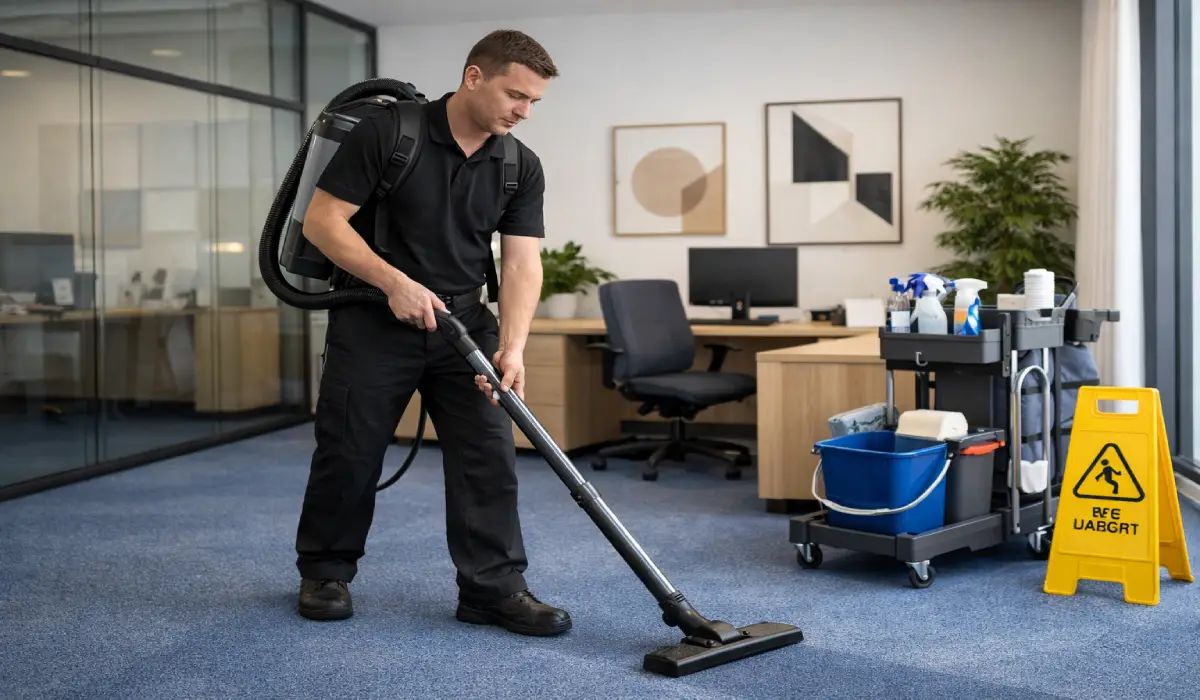
Weekly office cleaning is often the smartest solution for Parisian SMEs: it delivers professionally maintained premises at a controlled cost, without the logistical burden of a daily visit. The key is knowing exactly what it should include — and what your competitors are already doing.
At Ménage Parfait, we visit over 150 businesses every week across Paris and Île-de-France. This article shares our field protocol, real industry data, and the mistakes we most frequently correct when onboarding new clients.
Is a weekly cleaning schedule the right rhythm for you?
There is no universal frequency: it depends on your occupancy rate, your premises layout, and your sector. Here is our decision framework, built from 3 years of field experience in Paris.
What frequency suits your business?
The practical advantages of a weekly schedule
Beyond cost, a well-executed weekly clean offers real operational benefits that facility managers often underestimate.
- Total predictability: same day, same time every week. Your teams know that Monday morning (or Friday evening), the office is spotless.
- Simplified quality control: one visit to sign off per week, a clear checklist, a single dedicated contact.
- Equipment longevity: carpets, furniture, laminate flooring — regular maintenance multiplies their lifespan by 2 to 3 compared to one-off cleaning.
- Consistent professional image: a client or job candidate received on any day of the week will find well-kept premises.
What the law says: obligations and room for flexibility
Before setting your cleaning frequency, it is essential to distinguish what is a legal obligation from what remains at your discretion.
What is mandatory on a daily basis
The French Labour Code (articles R.4224-1 et seq.) requires employers to keep their premises in a consistently clean state. In practice, case law and occupational health recommendations establish daily toilet cleaning as an incontrovertible minimum standard.
What can be adjusted depending on your activity
Beyond the toilets, the cleaning frequency for other zones is left to the employer's judgement, provided the environment remains healthy and sanitary. Zones that can be covered on a weekly basis include:
- Workstations and desk surfaces — dusting, cleaning screens and keyboards, emptying waste bins.
- Floors (excluding toilets) — vacuuming carpets, mopping tiles or hardwood, skirting board treatment.
- Meeting rooms, relaxation areas, reception — full surface, furniture and interior glass cleaning.
The complete protocol for a professional weekly visit
A professional weekly visit cannot be improvised. The order of intervention, the materials used and the method have a direct impact on the quality of the result and the time spent. Here is our field protocol.
The order of intervention: a logic that prevents cross-contamination
A trained professional never works in a random order. The golden rule is simple: from clean to dirty, from top to bottom. Here is the optimal sequence for a complete weekly visit:
- Ventilate the premises — open windows or activate the ventilation system to renew the air before starting.
- High-level dusting — tall furniture, skirting boards, ventilation grilles, tops of wardrobes. Dust falls down and is collected from the floor afterwards.
- Contact surface cleaning — workstations, meeting tables, keyboards, phones, door handles, light switches.
- Kitchen and break area — surfaces, sink, shared equipment, emptying and replacing bin liners.
- Toilets — full cleaning and disinfection with replacement of consumables (soap, toilet paper, hand towels).
- Floors — vacuuming or sweeping, then mopping according to the surface type. Always last, to avoid soiling a clean floor.
What time should the visit take place?
The timing of the visit is crucial for quality of result and discretion towards your team.
- Before 8:30 am (recommended) — empty premises, full freedom of movement, visible result from the moment staff arrive. Our most requested option.
- After 6:30 pm — ideal if the premises are occupied in the morning. Some zones may require a quick pass the following morning.
- During the day (discreet) — only possible for light visits or in companies with many separate spaces. We advise against this option for a full weekly visit.
Eco-certified products: a requirement, not an option
At Ménage Parfait, we use exclusively products bearing the European Ecolabel or equivalent certification. These products disinfect with the same effectiveness as their conventional counterparts while preserving indoor air quality — an important criterion in enclosed workspaces.
Receive your weekly quote within 24 hours
Our experts assess your premises (area, zones, constraints) and send you a detailed proposal with a written specification included — no commitment required.
Request a free quoteFull weekly checklist — zone by zone
Here is the precise detail of what a professional weekly visit must cover. Use this list to evaluate your current provider or frame a new contract.
- Dusting and cleaning of screens, keyboards, mice and phones (microfibre disinfection)
- Cleaning of desk surfaces, desk mats and window frames
- Emptying and replacing paper bin liners
- Vacuuming or mopping floors according to surface type (carpet, hardwood, tiles, PVC)
- Dusting of skirting boards, desk legs and partition bases
- Full cleaning of the conference table and chairs (surfaces and legs)
- Cleaning of the whiteboard or presentation screen
- Cleaning of interior glazing and glass doors
- Vacuuming or mopping floors, emptying bins
- Full cleaning and disinfection of toilet bowls, seats, cisterns and surroundings
- Cleaning and disinfection of washbasins, taps and mirrors
- Floor washing and disinfection with bactericidal product
- Restocking of soap, toilet paper and hand towels
- Descaling of fittings and cleaning of internal bins
- Cleaning and disinfection of worktop surfaces, sink and taps
- External cleaning of fridge, microwave, coffee machine and dispensers
- Floor and skirting board mopping, emptying and replacing bin liner
- Cleaning of cupboard and drawer fronts (fingermarks)
- Floor washing of entrance, corridors and internal staircases
- Cleaning of door handles, light switches, banisters and lift buttons
- Dusting of reception furniture and display stands
- Cleaning of glazed entrance doors and windows (internal face)
- Dusting of tops of wardrobes, bookcases and high partitions
- Cleaning of ventilation grilles and air-conditioning grids
- Dusting of accessible light fittings and ceiling strips
The 5 mistakes Parisian SMEs make with their weekly office cleaning
When taking on clients dissatisfied with their previous providers, we have identified recurring mistakes. By knowing them, you can avoid them — or check that your current provider does not fall into the same traps.
Mistake #1 — No written specification
Many SMEs sign a "weekly cleaning" contract without detailing zones and tasks. The result: every provider interprets the scope differently, some areas are systematically skipped (tops of furniture, skirting boards, interior glazing), and it is impossible to flag non-compliance without a written reference document.
Mistake #2 — Underestimating the time required
A 150 m² office with open-plan space, two meeting rooms, a kitchenette and toilets requires between 2h30 and 3h of work for a complete and rigorous weekly visit. Budget providers offer 45-minute visits for the same scope. The result is mathematically impossible.
Mistake #3 — Ignoring toilets between visits
Even with an excellent weekly visit, toilets used by 20 people over 5 days without intermediate maintenance create a hygiene and image problem. The practical solution: a quick daily 15-minute visit dedicated solely to the WC and coffee area, in addition to the full weekly contract.
Mistake #4 — Neglecting contact surfaces
Door handles, light switches, keyboards and phones are the areas where bacteria and viruses spread most efficiently — and they are often the first zones sacrificed when the agent is short on time. A serious protocol dedicates 15 to 20% of intervention time to these surfaces.
Mistake #5 — No formalised quality monitoring
Without a visit sheet, quality control inspections or a dedicated contact, quality inevitably declines within a few weeks. A serious provider offers regular quality checks and a simple reporting channel (email, WhatsApp) to flag an oversight or non-compliance within 24 hours.
The 3 documents every weekly contract must include
- Written specification — zones covered, detailed tasks, frequencies, products used.
- Signed visit sheet — sent after each intervention, guaranteed traceability.
- Dedicated contact — a single point of contact reachable for any adjustment or report within 24 hours.
Weekly office cleaning rates in Paris and Île-de-France — 2026
The price of a weekly visit depends on two combined factors: the floor area and the number of workstations to maintain. Here are our real rates charged in Paris and Île-de-France, including products, equipment and travel.
| Area / profile | Duration / visit | Price / visit excl. VAT | Monthly excl. VAT (4 visits) |
|---|---|---|---|
| 50–80 m² — 5 to 8 workstations | 1h45 – 2h15 | €85 – €110 | €340 – €440 |
| 80–100 m² — 8 to 15 workstations | 3h – 3h30 | €140 – €160 | €560 – €640 |
| 150–200 m² — 20 to 30 workstations | 4h30 – 5h | €220 – €245 | €880 – €980 |
| 300 m²+ — 40 workstations and above | Following on-site audit | On request | On request |
Specific to Paris and Île-de-France
In central Paris and the inner suburbs (92, 93, 94), rates systematically include travel costs. The urban density and Paris air quality (fine particles, soot, pollen) require particular attention to glazed surfaces and ventilation systems — two areas often overlooked by generalist providers.
Weekly vs 2×/week vs daily: what is the right rhythm for you?
This table helps you make an informed decision based on your priorities.
| Criterion | 1×/week | 2–3×/week | 5×/week |
|---|---|---|---|
| Monthly cost (100 m², ~12 workstations) | €560 – €640 excl. VAT | €1,120 – €1,280 excl. VAT | €2,800 – €3,200 excl. VAT |
| Ideal profile | SME < 30 staff, flex office | 30–80 staff, open-plan | 80+ staff, intensive client reception |
| Toilets covered | Weekly (+ daily visit recommended) | Each visit | Every day ✓ |
| Cleanliness level | Very good | Excellent | Immaculate |
| Labour Code compliance | Yes (excluding toilets alone) | Yes | Yes ✓ |
| Indoor air quality | Good — regular maintenance sufficient | Very good — frequent renewal | Optimal — dust and allergens eliminated daily ✓ |
| Contractual flexibility | Very easy to adjust | Modular | Structured contract |
Switch to professional weekly cleaning
150 Parisian businesses already trust us. Find out why 97% of our clients renew their contract every year.
Get my personalised quoteHow to choose a weekly cleaning provider: 5 decisive criteria
The Parisian market has hundreds of providers. Here are the five criteria we recommend evaluating systematically before signing.
1. A detailed written specification
Any serious provider starts with a quote that explicitly lists zones, tasks and frequencies. If the proposal simply reads "weekly cleaning 100 m² — €180/month", walk away. You will never know what is included.
2. Team stability
Frequent staff turnover is a sign of a provider that underpays or poorly organises its work. An agent who visits your premises every week knows them inside out — they spot anomalies, manage zone-specific requirements, and develop genuine routine rigour.
3. A formalised quality control system
Signed visit sheets, on-site quality inspections, a fast reporting channel: these are not optional extras. They are the guarantee that quality will be maintained over time, not just for the first three weeks.
4. Certifications and insurance
Check: up-to-date URSSAF certificate, Professional Civil Liability insurance (minimum €1M), and ideally a certified CSR approach for the products used. These documents should be provided without hesitation on simple request.
5. Contractual flexibility
Your business will evolve — relocation, growth, restructuring. A good contract includes straightforward adjustment clauses: change of area, change of schedule, upgrade to a higher frequency without excessive penalties.

 01 89 19 68 69


