At Ménage Parfait, one conviction has guided our work for years: a cleaning service is not enough — you must also be able to prove it. When a client calls on a Monday morning claiming a restroom was not cleaned, without a written record, nobody can say for certain what happened. That exact situation is what led us to roll out traceability sheets across all our sites — well before our certifications required it.
In this guide, we share our free, interactive cleaning traceability sheet PDF 2026, along with everything the field has taught us: the fields that actually matter, the mistakes even the best agents make, and when (or not) to go digital.
What is a cleaning traceability sheet?
A cleaning traceability sheet is a document — paper or digital — that records every intervention carried out on a site: who intervened, when, which services were performed and which anomalies were observed. Displayed in a utility room or kept in a binder, it constitutes the official maintenance history of the premises.
Contrary to popular belief, it is not only useful in sectors with strict protocols such as healthcare or the food industry. In office environments — offices, coworking spaces, shops — it serves three essential purposes: it protects the client (proof that the contract is honoured), it protects the agents (proof of their attendance and work), and it defuses disputes before they escalate. A well-kept sheet is less a control tool than a trust tool.
A real case: the Monday morning the sheet saved us
In an office building we maintain, a manager reported one Monday morning that the restrooms had supposedly not been cleaned over the weekend. Before sending an emergency team or accepting the complaint, we checked the attendance sheet: the agent had signed off the intervention, the time matched the scheduled slot, and the team leader even had a photo taken during his inspection.
Digging deeper with the client, the truth emerged: an outside contractor had entered after our visit for technical work and left the premises in poor condition.
Download the free cleaning traceability sheet PDF 2026
Rather than a simple blank table, we designed a 15-page interactive PDF that mirrors exactly the structure our teams use in the field: a cover page to identify the site, an instructions page with service codes for fast completion, one page per month with the real calendar of the year (French day names, greyed-out weekends), and a quarterly quality-control page with client sign-off.
📄 Cleaning traceability sheet 2026 — Ménage Parfait
- ✅ 15 pages, one per month + instructions
- ✅ Fillable fields on PC and tablet
- ✅ Real 2026 calendar, greyed-out weekends
- ✅ 100% free, no email required
The interactive PDF remains our recommendation (locked calendar, guided filling). The Excel and Word versions are fully editable: add columns, adapt the codes, insert your logo. Need another year? The 2027 PDF is already available at /fiche-tracabilite-nettoyage/2027 — the document regenerates automatically every year.
The document opens and can be filled in directly in Adobe Reader, Chrome or Edge. You can also print it and display it on site: the agent sign-off and client visa columns are designed for handwritten signatures. No registration, no email: we would rather this template serve as many people as possible — office managers, property managers, independent cleaners or fellow professionals.
What does a well-kept sheet look like? Annotated example
A blank template doesn't tell the whole story. So here is a January 2026 page filled in exactly as our team does it on a typical site — a law firm in the 8th arrondissement cleaned every weekday evening from 6 pm to 8 pm (agent names have been abbreviated):
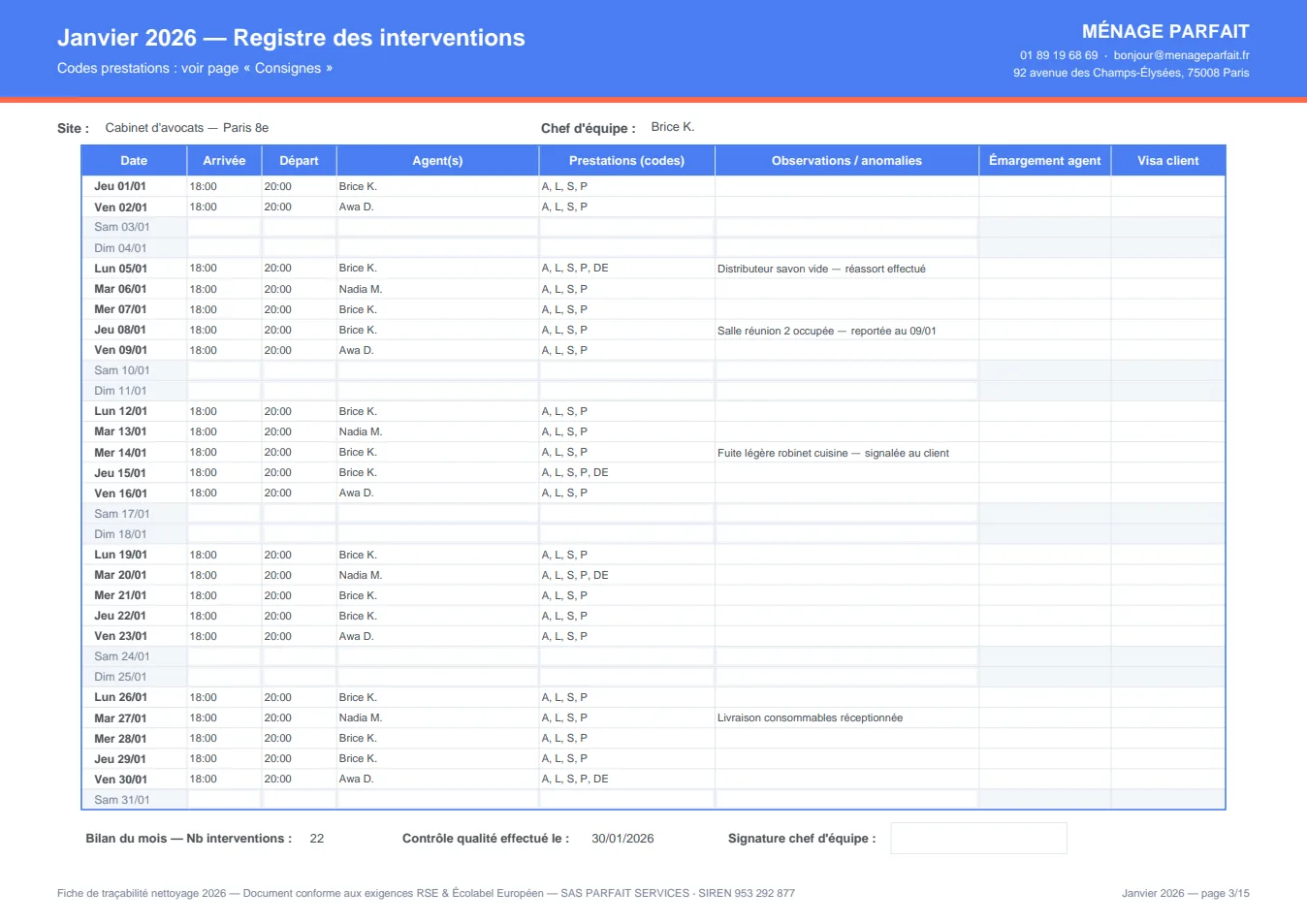
Three details deserve your attention. First, the consistency of the times (18:00 – 20:00 every working evening): this is what proves compliance with the contractual slot. Second, the service codes "A, L, S, P" that trace four tasks in five characters — the 2-minute rule in action. Third, the factual remarks: "Soap dispenser empty — restocked" on the 5th, "Slight kitchen tap leak — reported to client" on the 14th. Short, dated, actionable.
You can download this completed example as a PDF to show your teams during training or onboarding.
How to create a traceability sheet?
The best traceability sheet is not the most exhaustive one: it is the one your teams will actually fill in, at every visit, without exception. After years of practice across 150+ sites, here are the only elements that truly matter.
The 5 essential fields (and nothing more)
- The date — ideally pre-printed, to avoid mistakes and skipped lines;
- Arrival and departure times — in HH:MM format, they attest to compliance with the contractual time slot;
- The agent's full name — no initials alone; the sheet must identify the person unambiguously;
- Validation of the planned tasks — using short codes rather than endless checkboxes;
- Any remarks — a leak, an empty dispenser, damage, no access: anything out of the ordinary.
The 2-minute rule
Our internal standard is simple: filling in the sheet must take less than two minutes. Beyond that, experience shows it will be filled in late, at the end of the round, or approximately — and a sheet filled in from memory three hours later no longer proves anything.
Service codes: the secret to fast completion
To keep within the 2-minute rule, our template uses short codes: A for vacuuming, L for floor washing, S for restrooms, P for bins, DE for touch-point disinfection... The agent writes "A, L, S, P" instead of drafting a sentence. The full legend appears on page 2 of the PDF, to be displayed next to the sheet.
📌 Key takeaways
- One sheet = 5 fields: date, times, full name, validated tasks, remarks;
- Filled in immediately, before leaving the site — never later;
- Under 2 minutes per visit, thanks to service codes.
Looking for an office cleaning company in Paris that documents every visit?
At Ménage Parfait, traceability is included in all our services: attendance sheets, quality controls and reports on request. Free office cleaning quote in Paris, answer within 24 hours.
Request my free quoteThe 4 most common filling errors (seen in the field)
With 35 active agents, we see thousands of sheets every year. Errors are rarely a matter of bad faith: they come from the pace of field work. Here are the four we correct most often:
- Forgetting to sign before leaving the site — the sign-off is the heart of the proof; an unsigned sheet loses most of its value;
- Filling in the sheet at the end of the round instead of immediately after each intervention — times become approximate and omissions pile up;
- Ticking a task without noting that it could not be performed — locked office, occupied room, no access: the impediment must appear in the remarks, not vanish;
- Not reporting an observed problem — a leak, an empty dispenser or damage noted on the sheet triggers corrective action; unreported, they become a client complaint.
That is why, when onboarding every new agent, a few minutes are devoted solely to filling in the sheet. A tiny investment: a well-kept sheet prevents far more problems than it creates.
Paper sheet or digital traceability: which to choose?
It is the question every site manager asks — and software vendors have a ready-made answer. Ours is more pragmatic, because we use both every day.
Paper remains unbeatable on small sites
In small buildings, residential blocks or offices visited once or twice a week, a paper sheet displayed in the utility room or kept in a binder works perfectly. On larger sites, our team leaders photograph the completed sheet before leaving: if a client requests proof, we send it within minutes. A simple sheet used correctly beats a complex application nobody fills in.
Digital makes full sense on large complexes
As soon as you deal with several buildings, dozens of agents, staggered schedules or strong audit requirements, digital solutions centralise information, limit omissions and make monitoring far easier.
The real risk is believing that software replaces organisation. No tool will compensate for a poorly trained team or vague procedures. The best results always come from a sound working method first, then a tool suited to the size of the operation. Start with our free PDF; go digital when volume demands it.
Adapting traceability to the type of site: what the field taught us
The logic of traceability is the same everywhere, but the expected level of detail varies with the level of risk and footfall. Here is how we adapt it across our Paris and Île-de-France sites:
| Type of site | Client priority | Watch points | Expected proof |
|---|---|---|---|
| Traditional offices | Discretion and regularity | Off-hours visits, schedule compliance | Attendance sheet, weekly visa |
| Coworking spaces | Responsiveness to changing needs | Restrooms, shared kitchens, meeting rooms | Detailed sheet + reinforced monitoring of common areas |
| Medical practices | Protocols and sensitive areas | Proof of interventions, products used | Protocol-based sheet, product traceability |
| Shops & retail | Visit times, responsiveness | Incidents during opening hours | Precise timestamps, immediate reporting |
| Residential blocks & small buildings | Visibility for the property manager | Display accessible to residents | Sheet displayed in the utility room |
In standard offices, office managers primarily ask for visibility: knowing the team came, the planned services were performed and any issue was reported. Client signatures after every single visit remain rare in office environments; on larger contracts, a monthly report with field remarks and corrective actions is the most appreciated practice.
What French regulations say, sector by sector
It is the question we hear most often: "is a traceability sheet mandatory?". The honest answer: no text imposes a single sheet format, but several sector-specific obligations make cleaning traceability de facto unavoidable. Here is the overview, from the most regulated to the most flexible.
Food service: the strictest framework
Establishments handling foodstuffs are subject to Regulation (EC) No 852/2004, which requires procedures based on HACCP principles. In practice this means the Plan de Maîtrise Sanitaire (PMS), whose cleaning and disinfection plan is a pillar: who cleans what, with which products, how often — and above all records proving execution. During a hygiene inspection, missing cleaning records are among the most frequently noted shortcomings. If you run a restaurant, our template will serve as a base, but add the products used and temperatures if your PMS requires them.
Offices and workplaces: the employer's obligation
In office environments, the French Labour Code (article R4224-18) sets the principle: work premises and their annexes must be regularly maintained and cleaned. The text does not require a sheet, but in the event of a dispute — an employee invoking degraded hygiene conditions, a labour inspection — traceability is what allows the employer to demonstrate regular maintenance. It is also the argument we put forward to Paris office managers: the sheet protects the client company as much as the service provider.
Healthcare and care homes: traced bio-cleaning
In medical practices, clinics and care homes (EHPAD), cleaning becomes bio-cleaning: risk-zone protocols, standardised products, a precise cleaning order. Traceability is an explicit expectation of evaluation frameworks (notably those of the French Health Authority for medico-social establishments): during an evaluation or after an infectious episode, the establishment must be able to produce the intervention history, zone by zone. On these sites, our standard sheet is systematically enriched with a products column and a zone breakdown.
Schools and nurseries: local authority protocols
Establishments hosting children follow maintenance protocols defined by local authorities (town halls for schools, departments or operators for nurseries), considerably reinforced since 2020: increased frequencies on touch points, ventilation, products suitable for young children. The traceability sheet serves as much to manage frequencies as to reassure parents and school management.
Hotels: no obligation, but a reputation issue
No text requires a sheet in standard hotels, but it is the sector where timestamps have the greatest commercial value: faced with a guest review disputing the cleanliness of a room, proving the time of the visit and the services performed changes everything. The hoteliers we work with increasingly showcase traceability as a quality argument.
📌 Regulations: the essentials
- Food service: cleaning records mandatory via the PMS (Regulation EC No 852/2004);
- Offices: regular maintenance required by the Labour Code (R4224-18) — the sheet is the proof;
- Healthcare, care homes, schools: traceability expected by frameworks and protocols, with reinforced zone-based requirements.
Traceability, RSE certifications and audits: what is actually required
Our RSE and EU Ecolabel certifications do not prescribe a sheet format: they require us to demonstrate that our procedures are under control, and traceability is part of that whole. In practice, what matters is being able to show who intervened, when, following which procedure and — if asked — with which products. Paper or digital, form matters less than content. We keep our sheets long enough to answer any audit request or revisit a history; in practice, three years of retention covers almost every contractual situation.
Traceability as a continuous improvement tool
A common mistake is to see the sheet as a purely administrative document to archive and forget. For us, when an anomaly is detected, it triggers immediate corrective action — not mere filing. The recorded remarks feed our quarterly quality controls and our client reviews.
It is also thanks to this information that the vast majority of complaints we receive are resolved quickly: instead of pitting the client's word against the agent's, we check the sheet, and the disagreement becomes a factual verification.
Entrust your premises to a company that proves every intervention
RSE-certified office cleaning company in Paris, 35 salaried agents, rates from €26 excl. VAT/hour. Traceability sheets, quality controls and a dedicated contact included. Free quote within 24 hours, no commitment.
Get my office cleaning quote
 01 89 19 68 69


